Stonefly
Silent SpringStoneflies are stream-dwelling insects whose nymphs cling to rocks in fast-moving water and whose larval stages provide food for salmon. In Silent Spring, their disappearance after DDT enters a stream gives a concrete measure of ecological damage: the spray does not merely affect a target species but removes links on which other animals depend.
Habitat and Ecological Role
In the western plains and mountain country described in the book, animal life evolved in close relation to the demands of its habitat. That broader account of ecological adjustment informs the treatment of stream insects as part of a living system rather than incidental organisms. Stonefly nymphs occupy the rocks of swirling currents, alongside caddisfly larvae and blackfly larvae that edge stones beneath riffles and cascades.
These stream insects are food for salmon and trout. Their place in the stream is therefore both specific and connective: the nymphs live among the rocks, while their presence sustains fish at different stages of growth. A change in the abundance of these insects can carry consequences beyond the water-dwelling animals directly exposed to a spray.
DDT and the Stream Food Web
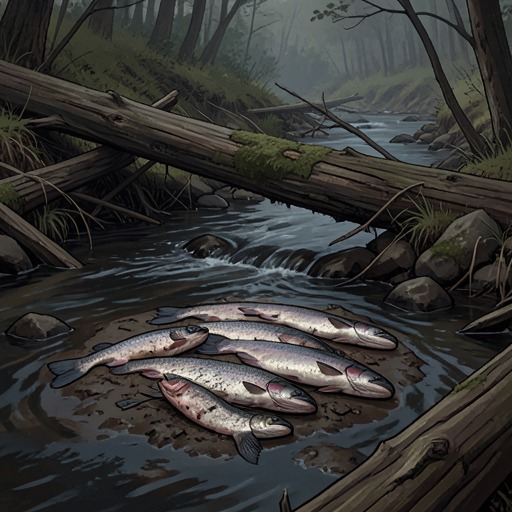
After DDT spraying, the account describes the stream as stilled. The insects were dead, and brook trout appeared among the dead fish; birds were dying along roads and in the woods as well. The loss of stoneflies was one part of a wider collapse in the stream's life, which had included the small organisms that form food for salmon and trout.
The effect did not end with the immediate die-off. The youngest salmon, or fry, might find suitable food again relatively quickly, but the larger aquatic insects recovered much more slowly. In the second year after DDT entered a stream, a foraging salmon parr could find little more than an occasional small stonefly. Large stoneflies, mayflies, and caddisflies were absent, leaving fish in their second and third years without the prey on which they depended.
Recovery and Significance
Canadian efforts to restore food to barren reaches of the Miramichi included transplanting caddisfly larvae and other insects. Such interventions could not quickly recreate the stream's former abundance: the larger aquatic insects had slow recovery, and supplying some organisms was not equivalent to restoring the relationships that had sustained the fish.
Stoneflies thus make the consequences of spraying legible at the scale of an individual stream and its food supply. Their absence connects chemical use to the difficulty of recovery: once the prey base is disrupted, the effects persist beyond the initial poisoning and reach salmon as they grow. The episode presents the stream not as a collection of separate targets, but as a linked community in which the loss of small organisms can determine what larger animals are able to eat.